
October 7 and the Middle East We Still Have to Build
The Virtual Embassy of Iraq in Israel and The Abrahamic Movement
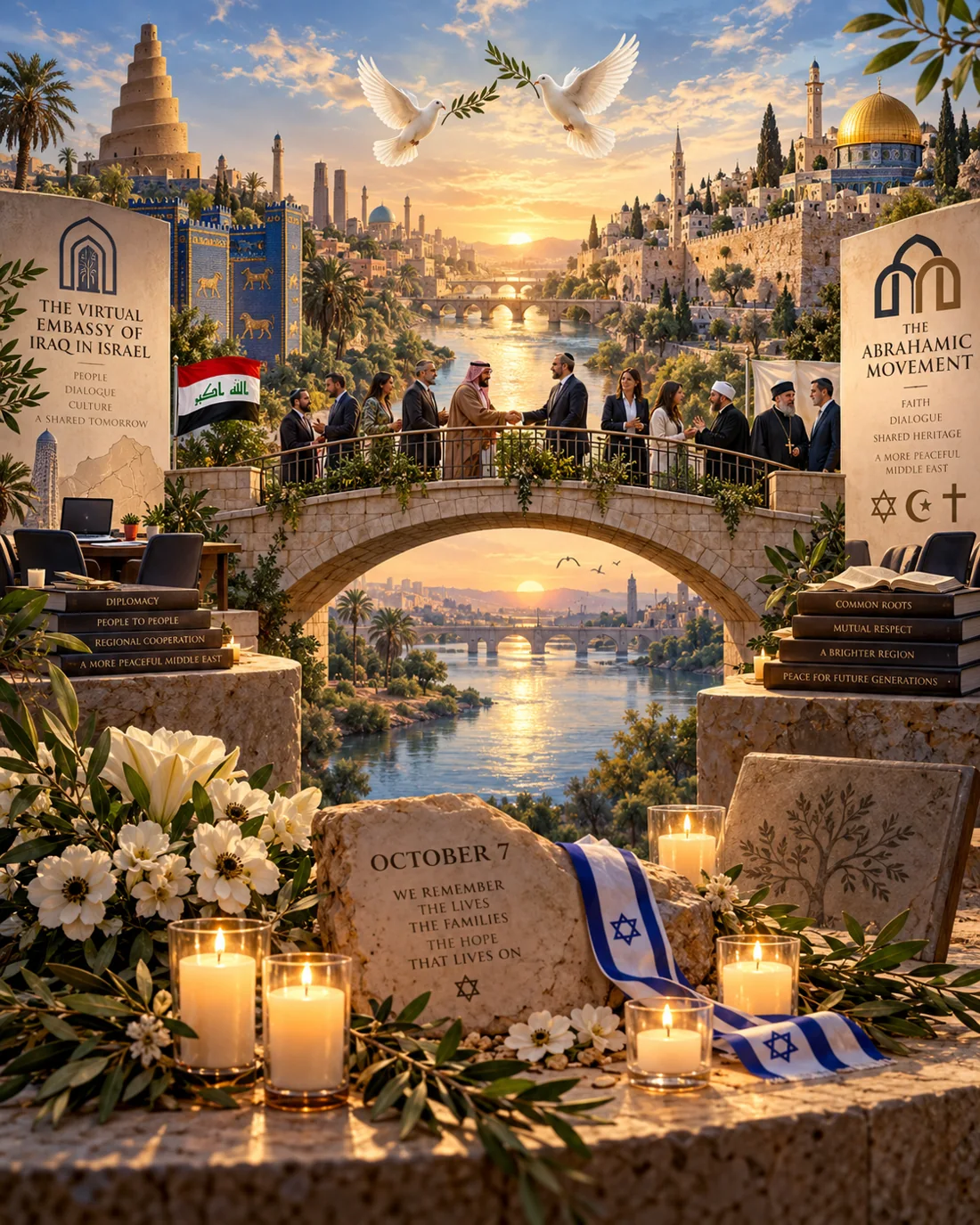
October 7, Memory and the Responsibility to Build
The events of October 7, 2023, remain a defining trauma in the contemporary history of Israel and the wider Middle East. The killing of civilians, attacks on communities and taking of hostages left families and societies confronting profound grief. Three years later, the anniversary raises questions not only about remembrance, accountability and security, but also about the kind of regional future that might emerge from continued conflict.
One central question is whether the Middle East can develop relationships strong enough to withstand political violence without surrendering its diverse identities, histories and legitimate national aspirations.
The Virtual Embassy of Iraq in Israel and The Abrahamic Movement represent two complementary approaches to this challenge. Their cooperation brings together independent civic diplomacy and interreligious dialogue in an effort to explore possibilities for future engagement between Iraqis and Israelis.
In a joint article published by Israel Today, The Virtual Embassy of Iraq in Israel and The Abrahamic Movement described their shared effort to build trust, encourage dialogue between Iraqis and Israelis, and prepare the civic groundwork for future regional cooperation.
The Virtual Embassy of Iraq in Israel: Civic Diplomacy Before Official Relations
The Virtual Embassy of Iraq in Israel operates as an independent civic initiative rather than an official diplomatic mission. Its stated purpose is to encourage dialogue, policy discussions and people-to-people relationships between Iraqis and Israelis.
Iraq and Israel do not maintain formal diplomatic relations. Their political disagreements and legal barriers remain significant. Nevertheless, the absence of government-to-government relations does not eliminate the possibility of intellectual, cultural, historical or humanitarian exchanges between individuals.
The concept of civic diplomacy rests on the distinction between official recognition and human engagement. Diplomatic agreements are decisions of sovereign governments. Civic initiatives can help create an environment in which public discussion, academic exchange, professional contacts and cultural encounters become possible.
This approach does not presume that diplomatic normalization is inevitable or imminent. Any future relationship would require decisions made through legitimate political processes, including consideration of Iraqi sovereignty and public interests.
The Abrahamic Movement: Shared Religious Heritage as a Basis for Dialogue
The Abrahamic Movement approaches regional reconciliation through religion, history and shared cultural memory. Judaism, Christianity and Islam all recognize Abraham as a foundational figure, while each tradition understands this inheritance through its own theology and religious history.
Shared heritage does not eliminate theological differences. It can, however, open opportunities for discussion across religious boundaries. Ancient Mesopotamia occupies an important place in traditions associated with Abraham, while Iraqi Jewish history provides a further historical connection between Iraqis and Israelis.
For centuries, Jewish communities contributed to Iraqi intellectual, commercial, religious, musical and cultural life. Baghdad held an important position in Jewish civilization. Many families in Israel retain memories and traditions associated with Iraq. Political separation does not erase cultural history.
The Abrahamic Movement emphasizes dialogue that acknowledges these relationships without requiring participants to surrender their identities.
Where Civic Diplomacy and Abrahamic Heritage Meet
The Virtual Embassy emphasizes civic relationships, policy conversation and shared practical interests. The Abrahamic Movement emphasizes faith, interreligious understanding and cultural inheritance. Together, these approaches invite discussion about the civic and intellectual foundations of possible future Iraqi-Israeli engagement.
Water scarcity, environmental pressures, food security, medicine, agricultural development, energy infrastructure and technology are regional challenges that frequently extend beyond national borders. Opportunities for knowledge exchange can be explored without pretending that political disagreements have been resolved.
Scientific cooperation does not require identical national interests. Cultural dialogue does not require theological agreement. Humanitarian engagement does not require the disappearance of historical grievances.
Remembrance and Accountability
Remembrance of October 7 is inseparable from the obligations to protect life, investigate crimes, secure accountability and recognize the suffering of victims. Security remains important, but another question also deserves consideration: what conditions could reduce the likelihood that future generations inherit the same patterns of fear and hostility?
Acknowledging historic connections does not resolve the Israeli-Palestinian conflict or diminish Palestinian suffering and political aspirations. Nor does it diminish Israeli security concerns. It offers a way to consider regional relations in which remembering violence and pursuing cooperation are responsibilities that can coexist.
Toward an Infrastructure of Trust
Enduring relationships between universities, researchers, professional communities, cultural organizations, journalists and religious institutions could sustain communication even where political disagreements continue.
Trust requires reciprocity, accountability, respect for rights and practical commitment. Historical connections can offer reasons to begin conversations; contemporary cooperation would depend on public legitimacy, mutual interests and respect for sovereignty.
The Virtual Embassy of Iraq in Israel and The Abrahamic Movement illustrate how civic dialogue and shared religious memory can frame such conversations without claiming to represent governments or to settle longstanding conflicts.
The Middle East Yet to Be Built
A more peaceful regional future would not require Jews, Muslims, Christians, Arabs, Israelis, Iraqis, Palestinians and other communities to erase their distinct histories or identities. It would require institutions and individuals capable of managing disagreement without permitting violence to define every generation.
The memory of October 7 remains important. So do the responsibilities of protecting civilians, recognizing the rights and aspirations of different peoples, and building relationships that can withstand disagreement.
The central question is not whether the peoples of the Middle East share the same history or vision of the future. They do not. It is whether they can develop enough mutual understanding to address differences without allowing violence to determine every generation that follows.